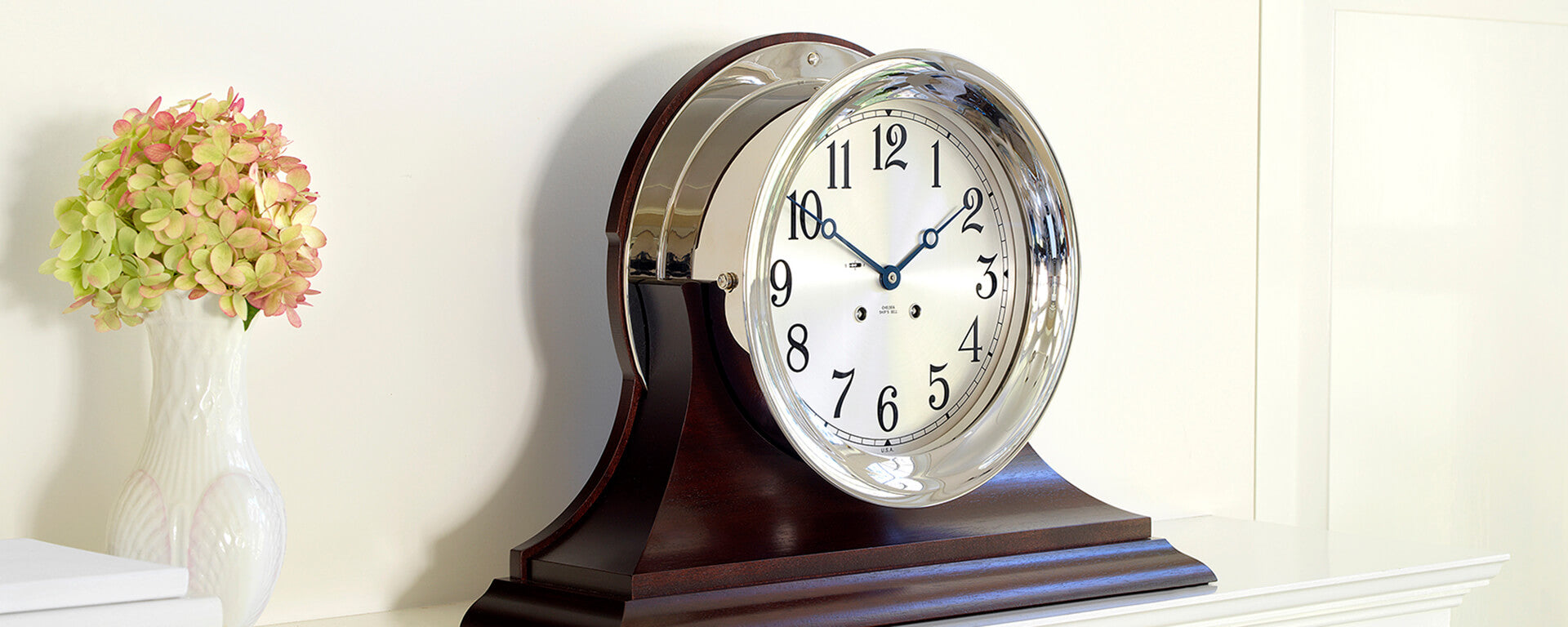
A century powering the iconic Ship’s Bell clocks, delivering precise timekeeping and a distinctive chime that marks the hours in a traditional mariner’s bell sequence.
Reliable, Handcrafted Timekeeping Since 1898
First introduced in 1898, the 4L movement carries forward Chelsea’s maritime legacy with handcrafted precision and the signature Ship’s Bell chime.
For over a century, the 4L movement has powered Chelsea’s Ship’s Bell clocks, delivering precise timekeeping and a distinctive chime that marks the hours in a traditional mariner’s bell sequence. The mechanism is built to perform consistently, whether at sea or in your home.
Each 4L movement is handmade in the United States using 364 precision brass parts. Chelsea cuts every gear rather than stamping it, ensuring smooth operation and lasting accuracy. Hand-wound mainsprings and a leather-covered hammer provide a rich, clear chime that has remained unchanged since the movement was first introduced.
The design itself is rooted in history. Chelsea’s original 1898 blueprints are still used today, and the knowledge to build and maintain these movements has been passed from one clockmaker to the next. Custom machinery allows Chelsea to manufacture its own precision parts, maintaining control over quality and performance.
It takes six weeks to assemble and test each movement. The result is a mechanical clock engine built to last, with the same reliability and signature sound that has made Chelsea clocks a trusted choice for generations.
Features
Marks time using the historic mariner’s bell sequence, creating a clear and recognizable hourly pattern.
Allows you to silence the chime when needed without affecting timekeeping.
Provide a rich, clear chime that has remained unchanged since the movement was first introduced.
Gears are cut rather than stamped, improving accuracy and long-term reliability.
A fully mechanical system built from precision parts designed to work together over decades of use.
Each movement is built by hand in Chelsea, MA. It takes over six weeks to ensure consistent performance and quality.
The design, sound, and function remain true to the original patented movement still used today.
Ship's Bell Story
Mariners have used a unique bell code to tell time at sea for hundreds of years. The code is based on the
crew’s typical workday routine while the vessel is under way. A ship at sea requires constant attention
throughout the day’s twenty-four hours. The day is therefore divided into six four-hour periods, each called a
“watch.” Similarly, the crew is segmented into three divisions. Division members then stand their individually
assigned duties on two watches per day, with eight hours off duty between watches. To rotate each division’s
watch times, the Evening Watch is periodically divided into two watches. These are called Dog Watches because
they “dog” the watch schedule for all divisions ahead by one watch period.
The watch officer struck the ship’s bell every half hour to apprise the crew of the time. A single bell
denoted the end of the first half hour and one bell was added each half-hour. Eight bells therefore signaled
the end of each four-hour watch. Like centuries of seafarers, you’ll soon know the time when the clock chimes,
even if you cannot see it.
Watch Schedule
First Watch
8:00 p.m. to 12:00 a.m.
Mid-Watch (also Black Watch)
12:00 a.m. to 4:00 a.m.
Morning Watch
4:00 a.m. to 8:00 a.m.
Forenoon Watch
8:00 a.m. to 12:00 p.m.
Afternoon Watch
12:00 p.m. to 4:00 p.m.
Evening Watch
4:00 p.m. to 8:00 p.m.
The watch officer struck the ship’s bell every half hour to apprise the crew of the time. A single bell denoted the end of the first half hour and one bell was added each half-hour. Eight bells therefore signaled the end of each four-hour watch. Like centuries of seafarers, you’ll soon know the time when the clock chimes, even if you cannot see it.